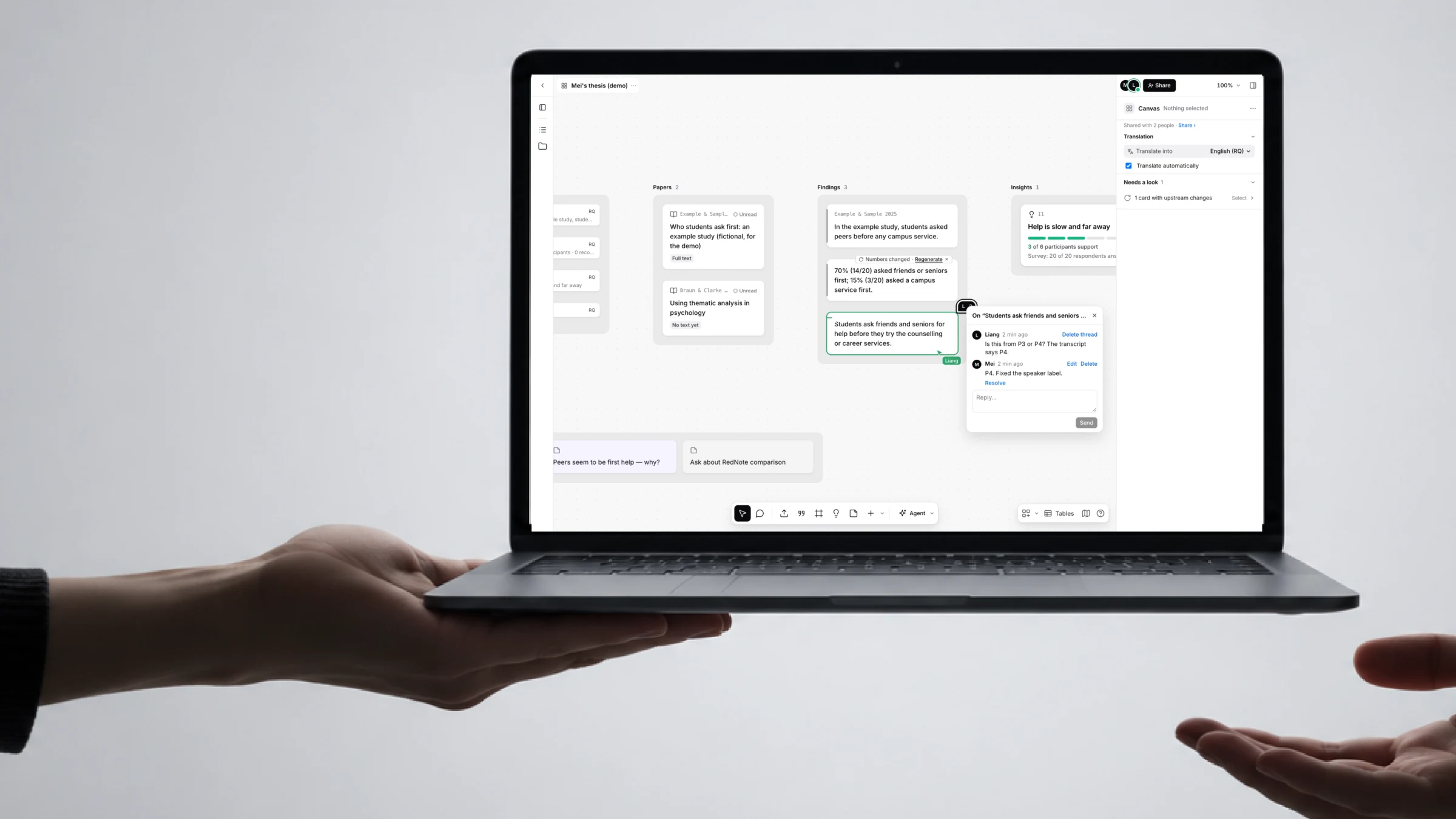
Research Canvas
An AI research workspace where every insight keeps its evidence · 2026
Who said this? Nobody can answer.
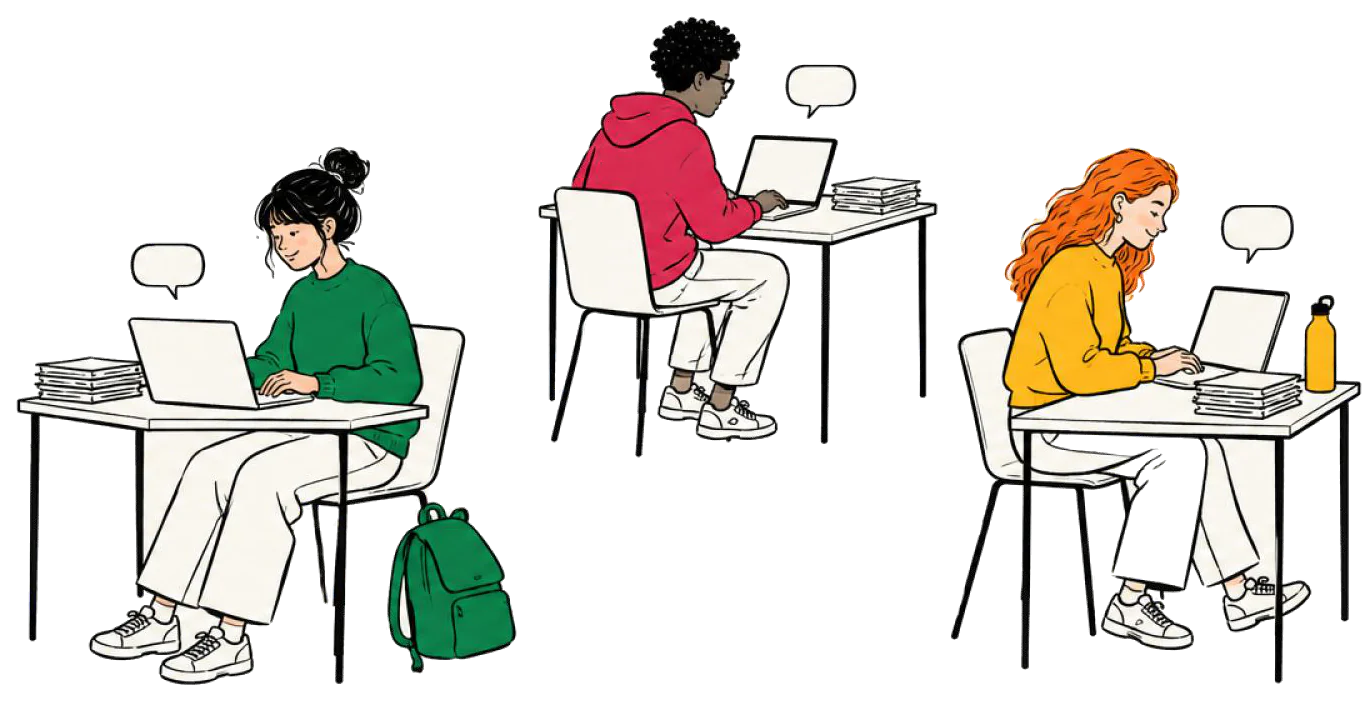
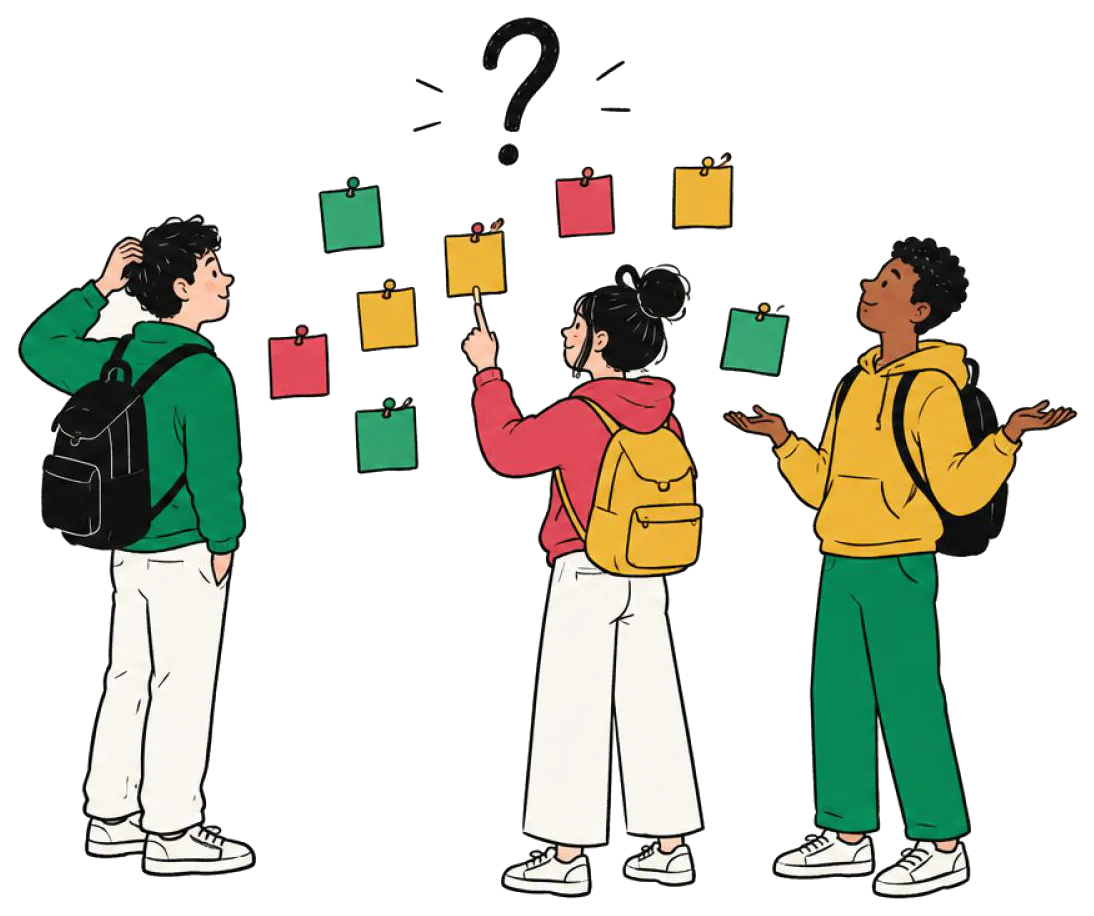 P2?
P7?
P11?
AI?
A week later, could they name the source?
184 people, in a CHI 2026 study by Zindulka and colleagues. That’s where a product decision gets made on something nobody can verify. It isn’t a discipline problem. It has to be solved in the tool.
A growing market that only sells speed.
Every tool in this space competes on speed. Very few deal with what speed costs.
The trust gap
80% use AI · 21% trust it unchecked
Of 332 researchers surveyed by Condens. The gap is where checking happens, by hand.
The category
Qualitative analysis software, by a Verified Market Research estimate. Dovetail alone was valued at $700M+ in 2022.
Where we start
6%14%
companies with no dedicated researcher
2022 to 2025, from 485 respondents to User Interviews. Designers and PMs run the research there. They are our first users.
Every insight keeps its receipts.
Today’s tools stop one click deep. Here the whole chain stays, and so does the evidence against.
An AI summary clicks back to one quote. How it got there is gone.
People
P1MFA, interaction design P2M.Des, service design P3M.Des, ex-agency P4MFA, UX design P5M.Des, notes only P6MA, design managementFindings
Insights
Select an insight to trace it.
AI writes. Rules count.
The model drafts the finding. Plain code checks the quote, counts the people, and flags wording the count can’t back.
Model drafts
"finding": "Most students find campus
            counseling too slow to help"
"quote":   "…the first intake appointment
            was in three weeks."
"support": ["P1", "P2"]
Code checks
Rule engine no AI
- Quote is in the transcriptmatch 0.97 ≥ 0.88 → found
- Each person counts once2 of 6 people → counted
- Wording fits the count“most” ≠ 2 of 6 → flagged
- Sources haven’t changedunchanged → current
Team sees
Most students find campus counseling too slow to help
2 of 6 support it · 1 contradicts it
“Most” overstates 2 of 6.
When a client asks “what’s this based on?”, the team opens the evidence.
The model is one slot. Everything around it is ours.
Swap in a better model by changing a setting. Counting, quote matching and privacy stay in plain code.
- IngestRecordings, PDFs, surveysread and transcribed on our server
- GuardPrivate stays private“Don’t send” passages cut; emails, numbers and listed names masked
- Model slotGPTpicked per action, swappableleaves the server
- VerifyNo AI herequote found, each person once, wording vs. count
- TraceEvery link keptcards, lines, AI batches and undo
- ShareTeam, livereports, and your own AI through MCP
P2Transcript excerpt, edited for the demo
Usually the portfolio round. Prof. Lin said email me at lin@example.edu.
Don’t send to AISo it was Fernhill Labs, the UX team at their Hangzhou office.
What the model sees in the cloud
- New model, same product. Change a setting, re-run the evals.
- The parts AI gets wrong are code. Counting and quote matching.
- One container. It can call a model on your own server.
We measured how it fails, misses included.
Fictional interviews and small test sets with known answers. We planted the bad quotes and the overclaims ourselves.
Plain code · quote matching
182/182
quotes the model pulled, all found word for word in the transcript
AI second check · bad evidence
35/36
swapped or cut-down quotes caught
11/11
planted overclaims caught
AI second check · false alarms
1/35
clean quotes flagged by mistake
Agent prompts: 90 of 90 test scenarios passed their checks, 30 scenarios × 3 runs on DeepSeek. Invented “he / she” went from 14 to 0 after a rule to call people by participant code, on a newer model.
One study, four stages, one canvas.
- Plan
- Collect
- Analyze
- Share
- PlanA question becomes a studySub-questions, then methods compared side by side. People choose; sample sizes come from a fixed list, not the AI.
- CollectInterviews, surveys, papersRecordings are transcribed on the server, with timestamps. Papers come from real registries, never from the model’s memory.
- AnalyzeQuotes to themes to insightsEach insight counts the people behind it, and the ones against it.
- ShareA report that keeps its sourcesBuilt from the canvas, quotes and counts included, for a team working on it live.
Only one tool does all four.
Dovetail and Atlas store and tag research. Miro AI and FigJam AI brainstorm. Based on their public docs, none keeps the rest.
| Tool | AI summary links to a source most tools do | The whole chain, insight to person | Evidence against an insight, kept on it | People counted by rule, not by AI |
|---|---|---|---|---|
| Dovetail | Yes | Not in their docs | Not in their docs | Not in their docs |
| Atlas | Yes | Partly | Not in their docs | Not in their docs |
| Miro AI | Partly | Not in their docs | Not in their docs | Not in their docs |
| FigJam AI | Not in their docs | Not in their docs | Not in their docs | Not in their docs |
| Research Canvas | Yes | Yes | Yes | Yes |
Free in class. Paid by the team.
Bottom-up, the way Figma and Notion grew: students use it for class projects and bring it to their teams. Planned pricing.
- One personFreeStudents and solo researchers try it on a study
- Teams~$20 per seat / monthSubscription with AI credits each billing cycle
- Organisations~$30k one-time + yearly supportTheir own deployment, their own models, their internal tools

We’re looking for pilot teams in universities and companies.
Talk to usMinwei Wu, Liang Zhou and Riley Chen: three UX designers, and our own first users. Built in 722 Applied AI at SCAD. Every person and quote on this page is fictional demo data.